CURE course helps bridge the digital divide among senior learners
- By: Indiana University Northwest
- Last Updated: April 30, 2026
For most people, the digital world is a gateway to information. For many seniors, it can feel more like a brick wall.
Indiana University Northwest’s Center for Urban and Regional Excellence (CURE) is looking to break down that wall, one class (and laptop) at a time.
“It’s very difficult because you’re trying to teach yourself or you’re dealing with some of these super young people who are in a rush with whatever they’re showing you,” Ayanna Wright, a 73-year-old Gary resident, said.
Wright has worked in gospel radio for decades, so she already had a base of technological information to build on. Still, there was plenty she didn’t know, and she was looking for a place to expand her skills.
She learned of IU Northwest’s CURE and its Senior University programs through a friend. CURE has offered adult education programs for decades, with topics covering computers, technology, artificial intelligence and so much more.
But one course in particular stood out to Wright.
Wright applied and was accepted into the Chrome Essentials course, a six-week program that focuses on using a Chromebook. Not only that, but the students were able to keep the devices after the course was over.
The Chrome Essentials course was made possible through CURE’s partnership with Senior Planet from Older Adults Technology Services (OATS), a charitable affiliate of AARP. While the class — teaching seniors about computers — isn’t a new concept, it’s unique because it gave graduates a laptop to keep after they completed the course.
IU Northwest assistant CURE director Amanda Smith emphasized the importance of giving the seniors a device to not only practice on, but to keep for themselves. In previous courses, students would learn skills on a specific device or operating system, only to go home where they’d have an outdated operating system or not have a device at all.
“It might not necessarily seem like a big gap for people who are used to technology, but to an older adult who this is very new for, that is a significant gap and something they couldn’t always overcome to practice their new skills,” Smith said.
Smith said she would love the work CURE put into this course to be replicated. She mentioned the opportunity — think of all the companies that do lifecycle upgrades on their devices, all the computers that might be slightly outdated but are perfectly usable to educate and connect our seniors to the digital world.
Whether it’s dealing with social security, checking your health claims, paying bills or even making a simple search, everyone deserves to have the confidence to access that information with their own devices.
“Our lives are going increasingly digital,” Smith said. “Whether we like it or not, whatever our opinions about that are or not, it is what is happening. … So there needs to be education around it because it’s not just intuitive for everybody.”
The initiative was sparked by Renee Patterson, a Senior University steering committee member who joined in 2025 with a vision to help those being “left behind” because they didn’t feel comfortable buying or using new devices. Utilizing Chromebooks, an inexpensive and easy-to-use device, creates a seamless transition from the classroom to everyday life.
And the interest was certainly there. There was a full application that was only open for a few weeks. Smith said more than 50 applicants applied.
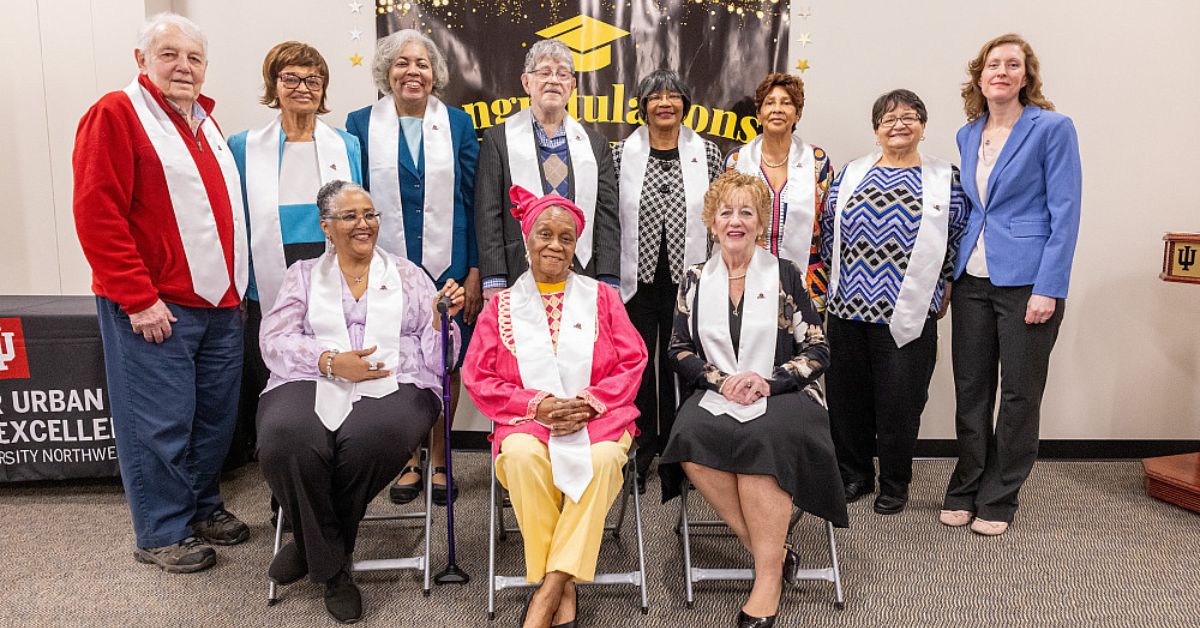
The class included students from Dyer, Gary, Hammond and Munster. The students came twice a week for six weeks, building their skills along the way. All 10 students graduated without anyone missing a single class.
That’s because, like Wright, these students were sharpening their skills — and having fun doing it.
“I enjoy the class. It’s a positive challenge,” Wright said. “It allows you the opportunity to further your education and your skills at the same time… it gives me the confidence that you need that, look, whatever this is, I can do it too”.
The class culminated in a graduation ceremony on April 27, where the students brought their friends and family to IU Northwest’s campus to celebrate their achievement, not of just finishing a course, but reclaiming their digital autonomy.
