Taking Baby Steps
- By: Powers Health
- Last Updated: September 3, 2026


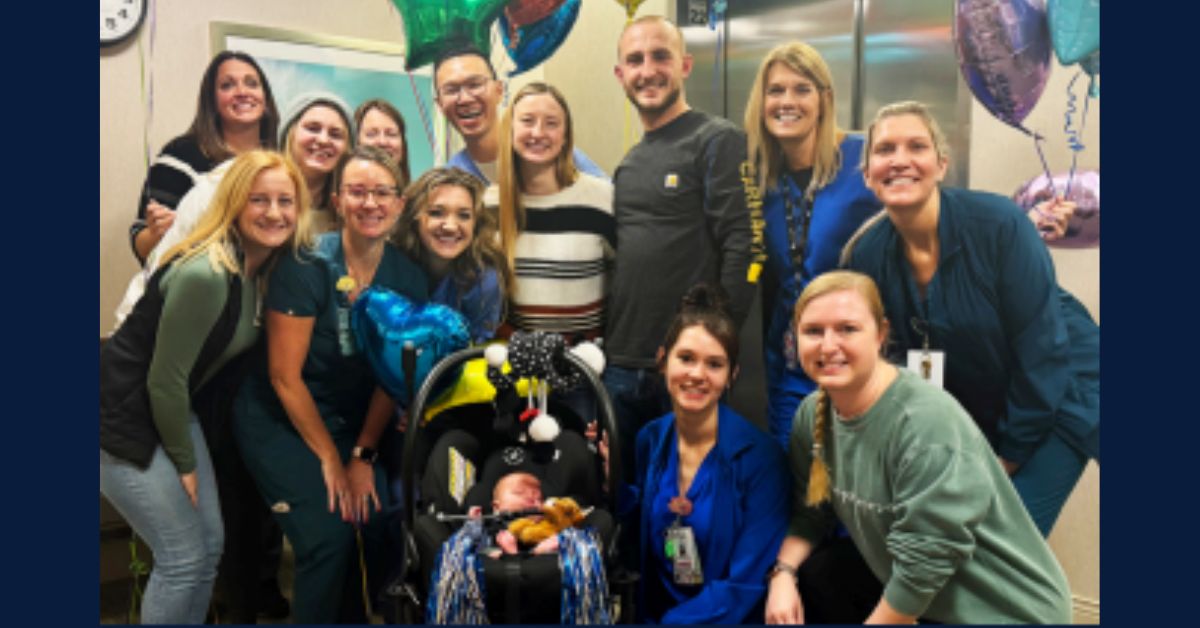
SHORTLY AFTER NOON on Thursday, Nov. 14, healthcare workers lined the walls near the Neonatal Intensive Care Unit entrance on the fifth floor of Community Hospital.
They chatted as they grasped ribbons tethered to brightly colored star- and heart-shaped balloons, occasionally peering down the hall as they awaited their little honoree.
The NICU doors opened. A stroller came into view, followed by a nurse and proud parents Taylor and Andrew White. The familiar notes of “Pomp and Circumstance” played from a nearby speaker. Then came the applause.
It was graduation day.
Hudson White, accessorized in denim suspenders and a green plaid bow tie, was nestled in his stroller with a stuffed animal that was about Hudson’s size at birth. Hudson was born at 1.7 pounds, 124 days earlier, and had had spent every moment inside the Munster hospital.
“We opened the door, and I heard the music playing, and then the waterworks started,” said his mother, Taylor White.
The 28-year-old is a nurse and clinical team lead in the Intensive Care Unit at St. Mary Medical Center in Hobart. Aside from morning sickness, her pregnancy had been progressing well.
“Everything was going perfect, until it wasn’t,” she said.
At her 20-week scan, her growing baby looked healthy.
“They couldn’t get all the pictures they needed because of how he was positioned, so they had me go back three weeks later,” White recalled.
When she returned, her cervix did not look quite right, and she began bleeding. A Powers Health obstetrician/gynecologist assessed White and her baby and knew they needed the high-level care provided at Community Hospital’s NICU.
“I was at 23 weeks, 5 days gestation the day I was admitted to Community Hospital,” White said.
Because of her condition, an exact dilation measurement was not possible, but her care team estimated she was dilated 5 or 6 centimeters.
“I was completely effaced,” she said.
Those signs indicated White was close to delivering the baby. She was put on bedrest and positioned in a tipped angle to delay labor as long as possible.
“We hoped it would be months, but I made it only a week before I went into full-blown labor,” she said.
A neonatologist conferred with the couple and asked if they would want their baby intubated after birth to increase his chance of survival.
“We said ‘yes’ because we wanted to give him a shot,” White said.
She delivered Hudson at 24 weeks and 5 days gestation. He was intubated and moved to the NICU, where he stayed for four months. He made progress and faced setbacks, including a partially collapsed lung.
“They say it’s a roller coaster,” she said. “The beginning was, for sure.”
To stay in a positive frame of mind, White avoided researching survival rates for her micropreemie and the meaning behind every test result. Having a medical background, she understood a lot of it anyway.
“Sometimes you know too much, like which numbers are good or bad,” she said.
She also knew Hudson was right where he needed to be.
“I’m glad that’s where we ended up,” she said. “Community Hospital has the best NICU in our area.”
Community Hospital is home to a Level III NICU, with Northwest Indiana’s most experienced team of neonatal specialists, physician assistants and nurse practitioners who are available around the clock.
Powers Health also sponsors a neonatal transport team that allows the healthcare system to care for premature and critically ill babies from local hospitals at Community Hospital’s NICU or transport them to a children’s hospital for further care or surgery.
“All of the NICU nurses, therapists and providers were great,” White said. “I can’t imagine us being anywhere else. You trust everyone and you get to know everyone.”
Tracy Sharp, nurse manager of Neonatology and Pediatrics at Community Hospital, said the NICU team has specialized training to care for the tiniest patients.
“We know this is an anxious time for parents. We want to assure them that we have an exceptional medical team and advanced equipment to give their babies the best chance at a healthy future,” Sharp said.
White spent all but two nights at the hospital with Hudson.
“I didn’t care about anything else,” she said. “Fortunately, we have a close family who stepped in to help at home and with our dogs.”
Her co-workers at St. Mary Medical Center, whom she refers to as her “work family” and “ICU crew,” visited and brought gifts to keep her mind and hands occupied at the hospital.
Looking back, she is grateful for their support. Looking ahead, she sees good things on the horizon for Hudson. Just a couple of months after graduating from the NICU, Hudson could roll over from his belly onto his back.
“He’s sleeping and eating great,” White said. “He makes cute noises. He’s very smiley now.”
His prognosis is good. Once hooked to monitors and under constant medical care, he now only needs a daily multivitamin.
