La Porte County BZA to Vote on Yellowstone Solar Project That Exceeds Solar Ordinance Requirements & Provides $24 Million in Tax Revenue

- By: Claire Kenney
- Last Updated: July 17, 2026



On Tuesday, July 21, the La Porte County Board of Zoning Appeals (BZA) will vote on whether to approve a special exception allowing the Yellowstone Solar project—which meets or exceeds all applicable requirements of the La Porte County Solar Ordinance—to proceed in southeast Johnson Township. Compact and carefully designed, the 100-megawatt Yellowstone Solar project would construct approximately 300 acres of panels and is the smallest utility-scale solar project in the Region. Yellowstone would also only be the second solar farm in La Porte County, with the other project being RWE’s 3,000-acre Bluestem solar farm. The total permitted acreage of 600 acres represents less than one quarter of one percent of the county’s 277,850 acres of farmland, according to documents submitted to the BZA.
With this land zoned Agriculture, the project requires BZA approval and has demonstrated that it fully complies with the requirements of the relevant ordinance. Approval by the BZA is not the final project approval. It would be the first step in an ongoing county permitting process, and Hoosier Solar would still need to secure approvals from other county boards and departments before moving forward.
“We are proud that Yellowstone goes beyond what the County requires. It is a limited-size project that brings substantial revenue to the community,” said Steven Lichtin, CEO of Hoosier Solar.
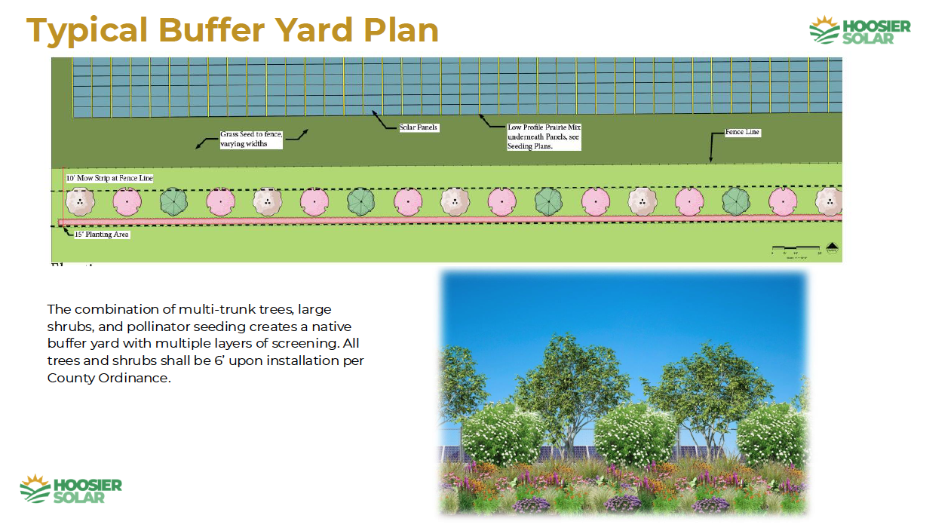
With self-imposed 500-foot panel setbacks from residences and a maximum panel height of 6 feet, the project’s visual impact is truly minimized. The landscaping that surrounds the project blocks neighbors’ views of the project and exceeds county requirements. The picture below provides a rendering of some of the 1,382 trees, 3,878 shrubs, and more than 210 acres of pollinator groundcover in the plans submitted to the BZA.
While the land used for the proposed project might be minimal, the benefits the project will bring to the area are significant. According to the documents submitted to the BZA, the project is projected to deliver approximately $24.5 million in local tax revenue over 35 years, compared with about $399,000 from continued agricultural use over the same period on the same site.
The revenue would come at a critical juncture as local governments across the state continue to grapple with the effects of the property tax reforms enacted through Senate Bill 1 in 2025. As Indiana’s property tax changes reduce revenue for cities, towns, and counties, Yellowstone provides a new source of funding without raising taxes on homeowners. That revenue goes directly toward schools, fire departments, the Sheriff’s Office, emergency services, roads, bridges, and other local needs — from the aging courthouse HVAC system to infrastructure projects that need to be moved up.
Additionally, the Yellowstone project would provide low-cost, locally generated energy to the Region at a time when energy prices are rising and demand for electricity is growing rapidly.
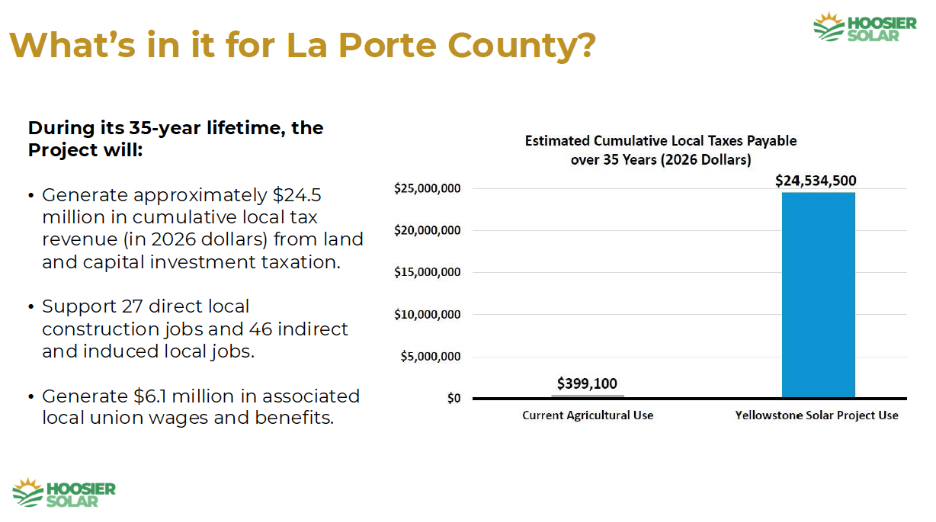
If approved, Yellowstone Solar would represent more than $200 million in capital investment in La Porte County. That investment would also generate around $6.1 million in local union wages and benefits, helping keep local workers employed and supporting local families. Simultaneously, it would support 27 direct local construction jobs, 46 additional jobs via project spending, and two long-term operations and maintenance jobs.
“Yellowstone will generate enough energy to power over 17,000 homes,” said Lichtin. “This would be a huge asset to the community, alongside the economic benefits.”
Solar panels are made of common materials like glass, aluminum, copper, and semiconductors commonly found in household appliances. Posts and racks to which the panels are attached are made of durable steel.
The project will protect soil and improve drainage with little-to-no grading or no topsoil disturbance. No vegetation will be removed before or during construction and operations, no trees will be removed, and there are no planned road or fence crossings of the De Waele Ditch.
The project is not permanent. After 35 years, at the end of the equipment’s useful life, it will be removed and decommissioned. The land itself will be fully available and in an ideal conditional for agricultural use thanks to decades of rest and well-maintained, protective ground cover.
Unlike many other enterprises, Hoosier Solar is approaching this project in a collaborative, community-centered way. It has already made large community investments, including a $105,000 permanent community fund with the Unity Foundation of La Porte County and a $100,000 investment in La Porte County Fairgrounds improvements.
“Hoosier Solar always works to include neighbors in our process, and we strive to be true community partners,” said Lichtin. “With Yellowstone Solar, we have gone beyond the ordinance requirements because we believe this project will preserve the local landscape and respect nearby neighbors. We will continue to work hand-in-hand with local leadership to ensure that our tax payments meet community needs.”
As a proactive precautionary measure, Hoosier Solar has built road protections into the proposed process. Under these conditions, roads would be reviewed before and after construction, and any project-related damage would be repaired at the company’s expense.
Additional financial safeguards will also be in place. Decommissioning protections will be required before construction, including financial assurances and a decommissioning bond posted with the county.
For more information on Hoosier Solar, you can visit hoosiersolar.com.