IUOE Local 150: A legacy of skilled workers, strong communities, and protecting working men and women

- By: Garrett Spoor
- Last Updated: November 23, 2026




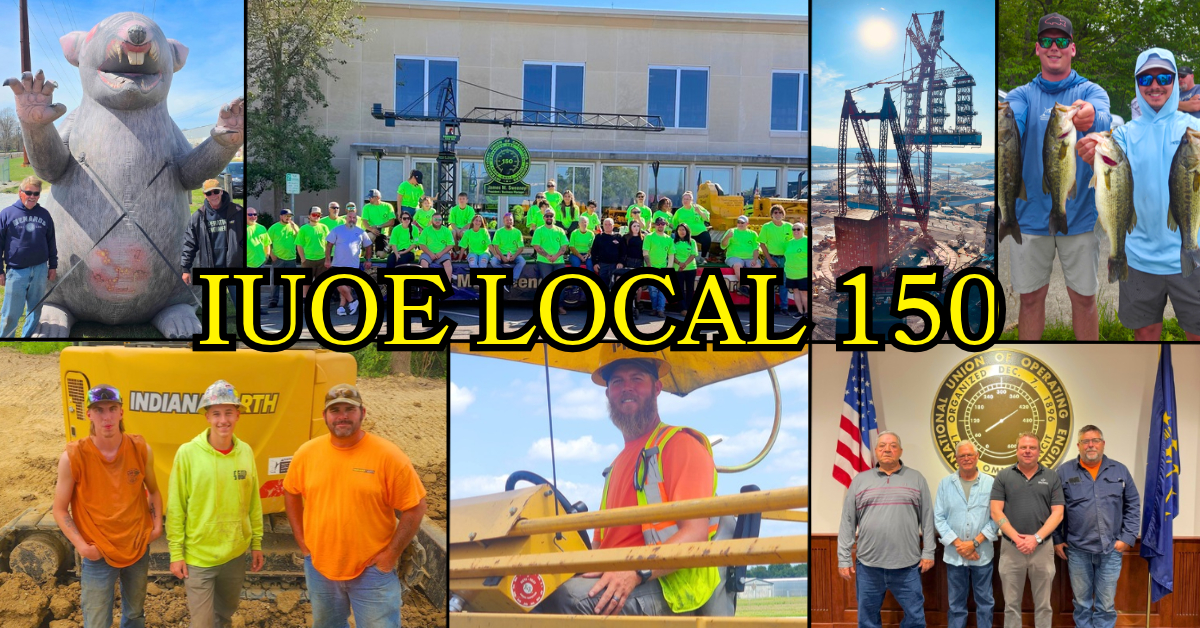
Across Indiana, Illinois, and Iowa, the International Union of Operating Engineers (IUOE), Local 150, AFL-CIO, represents the hardworking men and women who build infrastructure, support industry, and keep its communities moving in the right direction.
Local 150 is about turning skilled work into strong union jobs, contracts, and legitimate careers. Highway construction, building construction, quarries, landfills, equipment rental companies, and more are some of the various industries that make up Local 150.
Local 150’s story dates back to more than three decades before the current local was established, when 11 local unions met in Chicago to form the National Union of Steam Engineers. Their work established a tradition of skilled people mastering powerful machinery. Local 150 formed on May 8, 1929, when Chicago’s Local 569 and Local 42 came together. One year later, Local 464 joined. In the Quad Cities, Local 537 would merge with Local 150 in 1991, kicking off another chapter in operating engineers working on both sides of the Mississippi River.
Local 150’s history spans across many generations of leadership and membership. William F. Maloney served as the President-Business Manager from Local 150’s founding in 1929, up until 1940. Leaders such as John Lynch, William Law, James P. Crane, William F. Martin, and Thomas Rodd followed over the next 46 years.
In 1986, the membership elected William E. “Bill” Dugan, who helped launch a campaign known as Operation Wrench to organize mechanics in construction shops, heavy equipment dealerships, and rental and repair shops. The organizing department took shape in 1987, when Dugan hired James M. “Jim” Sweeney as the union’s first organizer, who serves as President-Business Manager today. Shortly after, Bob Paddock and David A. “Dave” Fagan, who serves as Financial Secretary today, joined him.
“I’ve been fortunate enough to go on for more than 47 years as an operating engineer,” Fagan said. “Business Manager Sweeney and I have worked together for 37 years, along with Bob Paddock who’s now retired, and we started off as organizers. We had approximately 9,000 members and a diminishing market share. We’ve gone from that to where we’re at today with over 24,000 members and an organization approaching $11 billion in assets.”
This growth came after decades of labor unions fighting to protect the rights of the workers, which has developed Local 150 into a powerful force for working people today. Longstanding leadership has also been a critical component to how Local 150 has been able to grow, especially in recent decades.
“We have incredible leadership with our officers. Whether they’re at work, at home, on the weekend — it’s nonstop. The foresight and the planning that they have, it’s a very strategic thought process of what we can do to protect members,” said Kristine Kavanagh, communications director of Local 150.
Local 150 operates a training facility where members can receive heavy equipment and mechanical training. The William E. Dugan Training Center, located in Wilmington, Illinois, is more than 300 acres and 342,000 square feet of space. The training center includes over 200 pieces of heavy equipment, 30 classrooms, a construction material testing lab, a state-of-the-art welding facility, an equipment simulator lab, and a 200-seat auditorium. Instructors are available to members six days a week, Monday through Saturday, excluding holidays.
“Members can attend that training facility and receive all the training they would like at no cost. If they live outside a certain radius, we will pay for their hotel room, but they don’t incur that cost to come to our training facility,” Fagan said. “We budgeted approximately over $30 million for this year in training. We operate and are self-insured with our health and welfare. We operate a pension fund. We operate a retirement enhancement fund. We operate a retiree medical savings account.”
Local 150 is always preparing for the next generation, and aspiring operating engineers can apply for the Local 150 apprenticeship program. According to Fagan, more than 300 apprentices were brought in over the past two years as operators, mechanics, or within the testing industry.
While Local 150 operates throughout the northern region of the state, thousands of members live in Northwest Indiana. This includes communities such as Gary, Valparaiso, and parts of Jasper County.
“A couple projects recently have added tremendous economic value to our members and, quite frankly, Northwest Indiana,” Fagan said. “Solar projects have taken place in the southern part of our jurisdiction. On one of those, the Mammoth Solar Field, we had approximately 330 members working there, and because of that project, we were able to increase and have 60 new apprentices starting their career for the first time on that project. Right now, a lot of our members are employed at data centers from Granger to La Porte to Michigan City. Those data centers are creating tremendous economic value not only for young people to start their career, but for long-term jobs that allow a member to have some predictability on his economic earnings.”
Building security that lasts beyond a workday is vital for Local 150. In 1953, the first fringe benefit fund, Midwest Operating Engineers Health and Welfare Fund, was prominent for negotiations of employer contributions. This made health and family security a central part of what a union contract could deliver. This commitment today extends not only to the members, but also to their families, which is roughly 58,000 lives.
In 1963, the union proposed a 10-cent-per-hour employer contribution to create a pension benefit. The first pension check was distributed to six members, and decades later, these early steps led to the foundation of the Retiree Medical Savings Plan in 2007. This helped members manage healthcare expenses in retirement. In 2008, the Retirement Enhancement Fund followed to supplement members’ retirement.
The ease of travel is another point of emphasis for Local 150. With the unpredictability of major highways such as Interstate 94 or Interstate 65, issues of congestion, traffic, and delays can impact thousands of people every day. Implementing a safe, efficient infrastructure system is also valuable for the small businesses and other companies that reside near I-94 or I-65.
“In terms of road construction and bridges, that affects every day traffic,” Kavanagh said. “The more you have skilled labor and expertise on site, you have people who know how to complete the project and stay on time. With Local 150, every member brings that to the table.”
What separates Local 150 from some other labor unions is not just the opportunities, but also the commitment to its members. Fagan emphasizes that Local 150 is always willing to spend the time and resources needed to support their communities and small businesses within its geographical area.
“We have diversified industries where we have equipment dealers, slag industry, landfills, and quarries. A lot of other trades don’t necessarily have that diversification,” Fagan said. “Local 150 is well-known for protecting the interest of its members when we go out and fight every day to protect the workforce of Northern Indiana, and we will not walk away from that battle.”
While Fagan pinpoints the wages and benefits as some positives that come with being a part of the Local 150, he appreciates how many people join the organization with the desire to stay long-term.
“When someone becomes an operating engineer and a member of this organization, you don’t see them leave within a few years. The amount of people who work here for 30 or 40 years, in some cases longer, is probably something that most people don’t realize,” Fagan said. “This is not a place where someone has a job; it’s a place where somebody develops a career.”
For additional information on Local 150, or to learn more about applying for an apprenticeship, you can visit local150.org.
