IU Northwest art students featured in international exhibition
- By: Indiana University Northwest
- Last Updated: April 14, 2026


Collaboration is paramount for Giselle Mira-Diaz. An internationally exhibited artist and visiting lecturer in photography and digital arts, she’s been interested in collaboration across international borders since she was an undergraduate.
Back then, she participated in International Art Collaborations (INTAC), a program that connects art students worldwide. As a result of the program, her work was exhibited in a gallery in Finland.
Mira-Diaz studied art education, highlighting INTAC in her thesis. She looked at how artists on different sides of borders break away from those barriers and collaborate to make art.
“Community, collaboration and these kinds of dialogs are more important than ever,” she said. “When we expand our horizons, we see ourselves within each other.”
When Mira-Diaz was appointed to a position at Indiana University Northwest, she wanted her own students to experience the benefits of international collaboration.
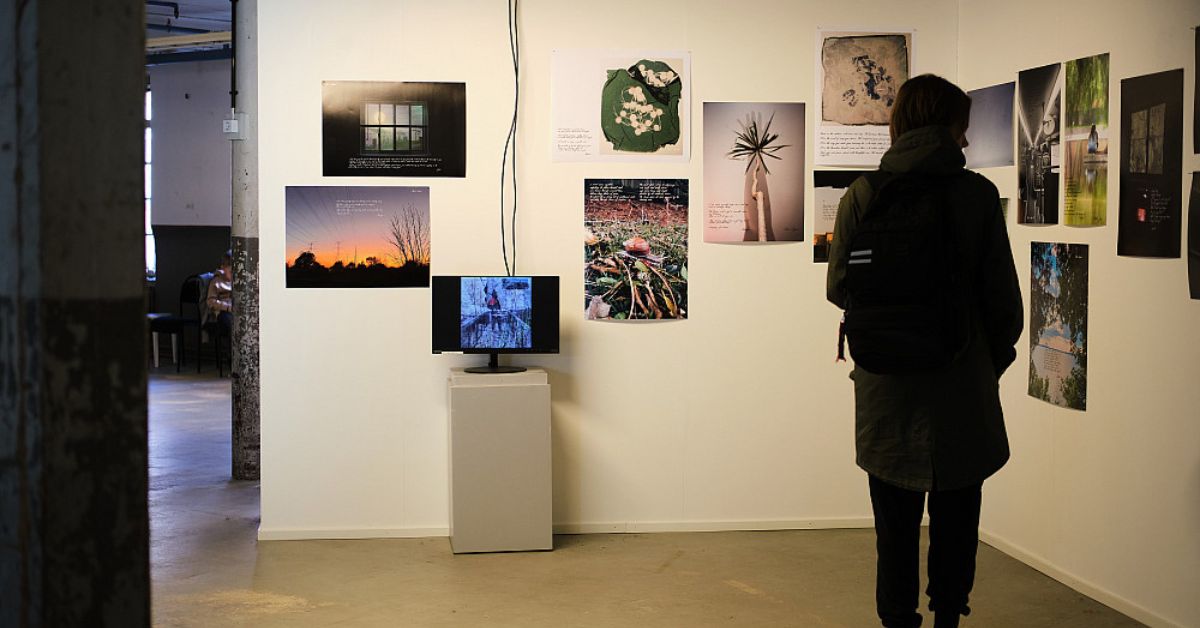
Over the Fall 2025 semester, her Topics in Studio Art class split into groups and worked with artists across the world as part of INTAC. Each group — made up of students from places like Canada, Mexico and Japan — worked together to create a cohesive art piece that would be exhibited at Himmelblau Gallery in Finland.
“For the first weeks, students were getting to know one another and different cultures,” Mira-Diaz said. “In the fourth week, we started working with the theme. Students who had similar ideas end up working together.”
This year’s theme was “Home Is a Feeling.” Students interpreted it using a wide range of media. Some used their painting skills, while others contributed photography and graphic design. One student even brought in their creative writing talents.
For Theo Coffin, the project was intimidating at first.
“It was a bit tough going into it because it’s largely digital work, and I’ve always been very analog,” he said. “That’s where compromise came in, because I had to figure out how to meet everyone else where they were.”
Ultimately, Coffin and his group came to the consensus that home isn’t a place, but more so the memories and comfort associated with a space.
“We each took photos of places that felt like home and made a series of collages,” he said. “Like new homes with little pieces of each of us.”
Coffin typically works solo on things like sculpture, paper mache and painting, but collaborating with other artists taught him a lot about teamwork.
“That is really important to carry with me as an artist — balancing when I should step up and knowing when to step back and listen,” he said.
Teamwork is just one benefit of international collaboration. INTAC allows students to learn more than just specific art techniques. Mira-Diaz highlighted the soft skills employees look for, like communicating with someone when English isn’t their first language and addressing different cultures and social norms.
But what’s most rewarding for Mira-Diaz is seeing her students build their confidence, both at home and on the international stage.
“I look forward to celebrating what they’ve accomplished. I know how hard it can be, but that’s all part of the learning process,” she said. “I just really love to see how confident the students grow over time.”
Gnat Djuras got to see her final piece displayed in person. In March, she traveled to Tampere, Finland, to experience the exhibition for herself.
Her group based their work on a poem, then used photos to capture the sense of nostalgia we feel when thinking about home. Djuras painted the background that connects all the photos.
“It means everything to me that I can branch out and expand my horizons with different corners of the world and get different perspectives,” she said.
For Djuras, the project was all about teamwork and understanding. She said that, among all the scheduling conflicts, they always found ways to be compassionate.
“It’s not just working together. It’s getting to know each other and finding each other’s strengths and weaknesses,” Djuras said. “If someone doesn’t know how to do something, someone else will help.”
While she was the only representative from her group in Finland, she did have a chance to see other groups’ work and explore the city of Tampere.
“There were a few galleries we frequented, and some of the people who curated these galleries were INTAC alumni and know Giselle (Mira-Diaz),” she said.
That’s what really sets INTAC apart as a learning experience — the community aspect. Mira-Diaz knows firsthand the camaraderie that comes with being an INTAC alumna.
“We’re consistently supporting each other and sharing different opportunities,” she said. “We are a very diverse group of people, but because of our hunger for networking and collaboration, these projects continue.”
t’s a full-circle moment for Mira-Diaz to see her students’ work exhibited in the same country and through the same program that once benefited her as an undergraduate.
For her students, INTAC is opening professional doors they might not have had otherwise.
“Art is a very competitive field. But once they start developing their CVs, I feel like they have the skills to go out into the world and make these kinds of opportunities for themselves,” Mira-Diaz said.
For one, Coffin is incredibly grateful for INTAC and the benefits it’s afforded him so far.
“This is my first real exhibition, and to do it internationally is such an incredible opportunity,” Coffin said. “I never would have thought I could have done this. It makes me feel like I could do anything.”
“I’d urge anyone to be a part of it, because it’s just so worth it,” Djuras said. “The art world can be scary, but we’re all more similar than we think. It’s just breaking down the borders of what we believe about each other.”
