Veteran Spotlight: Katie Payne
- By: Veronica Shloss
- Last Updated: April 4, 2026





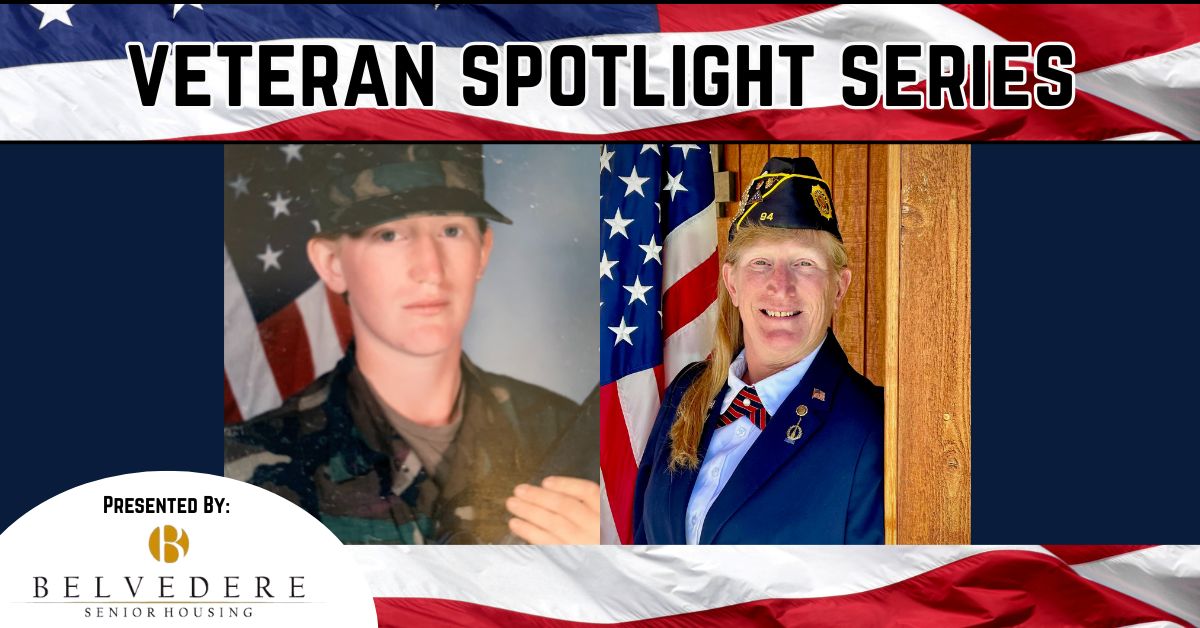
Growing up in Kouts, Katie Payne knew from a very young age that she wanted to join the military. After high school, she attended St. Joseph’s College, considering a future teaching math or science. After one year, however, she knew where she really belonged.
“In my heart, I knew I wanted to be in the military,” Payne said. “When I was about 9 years old, Vietnam had just ended. At 9, they won’t take you. I went to college eventually, but I knew I didn’t want to be there at the time. I left and joined the army.”
Payne was first stationed at Fort Hood. As a 31V, Payne’s duties included mechanical work as a tactical communications systems operator, which fit right into Payne’s longtime aptitude for electronics and mechanical work.
“I discovered that I had a knack for it when I was a kid,” Payne said. “My parents had a council stereo system back in the day when they still had eight-track players. It wasn’t working, so my dad put it in the basement, and I just started fiddling around with it. I have no idea what I did, but I got it working. I love working with my hands. I grew up being taught how to work on cars, trucks, tractors, farm equipment, as well as electrical, mechanical, and construction. My calling was towards fixing things.”
Working with her hands became a useful asset during Payne’s time serving overseas during the Gulf War. After training in Germany, Payne served in Iraq and Kuwait as frontline support for the 82nd Airborne Division, the 101st Airborne Division, and the 24th Mechanized Infantry Division under the 18th Airborne and Central Command.
“Our whole purpose was to move munitions and supplies to the forward units,” Payne said. “We had a very small number of women in the unit. I think we kind of developed a very close bond, no matter what position we had while we were there. That helps you not feel completely isolated. Having been raised to learn to fix things on my own, I know I would take my truck into the motor pool, and I would work on my own vehicle, which was fun.”
Payne believes that one of the more difficult experiences she encountered was the force of the sand, especially during storms. While soldiers wanted to relax in what little free time they had, the few opportunities for this were often ruined by the weather.
“The movies we had were VHS, and that would work until the sand would eat the tapes up,” Payne said. “I went through three cameras over there, just because the sand permeated everything. We would hit brownouts that were shutting our vehicles down so that the intake valves would not suck air from the fan into the engines. You would close up the windows, put goggles on, put a mask over your face just so you weren’t inhaling as much as what was being blown at you, because you literally could not see past the end of your vehicle.”
The sand problem became another way Payne’s work was valuable. As a mechanic, she was able to use her skills to solve problems they encountered from the weather.
Since Payne’s Expiration Term of Service (ETS) in 1994, she has continued to stay connected with her fellow veterans in a number of ways.
“The first group I got involved in was the American Legion,” Payne said. “At the American Legion Post 94 in Valparaiso, I was commander, first vice, second vice, adjutant, and chaplain. I have an honorary life membership at the post. I’m a life member with the VFW. I’m a life member with an organization called the Forty and Eight, which is an honor society of the American Legion.”
Payne is also a life member of the Disabled American Veterans (DAV), where she is a chapter service officer. In this role, she helps veterans receive their benefits.
“I’m very passionate about that because it was the DAV that finally helped me get my benefits and get me connected with the right people to get the right paperwork,” Payne said. “I had no idea how to fill out the paperwork.”
My thought after they helped me was that I need to pay this forward, so I have been doing that, and I enjoy doing it. The camaraderie is incredible, and it’s very satisfying when you see veterans start to get their benefits and then get increases in their disability ratings. Our country made a promise. I feel like I’m helping the country keep its promise.”
Payne also pursued schooling for industrial maintenance, and her first job in this industry after the service was at the Orville Redenbacher Factory. She pursued a maintenance job there despite being told that her chances of getting hired were low.
“I had a bunch of guys saying, ‘They’ve never hired a woman in maintenance. They’re never going to hire a woman in maintenance.’ I made them all eat their words,” Payne said. “Instead of taking my breaks, I was going to the shop, learning how to rebuild the parts, and reading all the tech manuals. If there was an extra tech manual, I would take it home and read it so that I became familiar. Six months after hiring in, I was qualified to operate all of the equipment. Six months after that, I was hired into maintenance.”
Payne retired at age 50, but she has not slowed down. She discovered she has a talent for art, and as with all of her other gifts, she is not letting it go to waste.
“I lost my son on February 12, 2019,” Payne said. “He was a Kouts firefighter and a Kouts reserve police officer. Kouts has a festival called Pork Fest, and every year, I have a booth outside the Kouts police department where I sell my art. The police department arranged to get a memorial scholarship in my son’s name at Kouts High School, so all of my paintings, whether I sell them at Pork Fest or if I sell them on my own, everything I make goes to that scholarship.”
Payne’s son, Nicholas William Deal, was lovingly nicknamed “Fuzzy” by his fellow officers. The name of the scholarship is the Nicholas W. “Fuzzy” Deal Memorial Scholarship.
As Payne enjoys her retirement helping fellow vets and students who are starting out in life, she has advice for anyone who is thinking about joining the military.
“Being a veteran, serving is not for everybody,” Payne said. “When you sign on that dotted line, you better be willing to fulfill the commitment. If you’re going to join, join for the right reason.”
Payne is confident she has fulfilled her own reasons for joining by continuing to serve and connect with the veteran community, viewing it as a gift and a reward at the same time.
