Indiana American Water Leads Indiana in Building the Next Generation of Certified Water Operators

- By: Garrett Spoor
- Last Updated: September 28, 2026


Developing the future of its workforce is a big part of why Indiana American Water has been able to successfully provide water in statewide communities since 1886. The company has continuously achieved this in part through building up the next generation of operators through certification programs with classroom learning, field exercises, hybrid instruction, and instructor-led discussions.
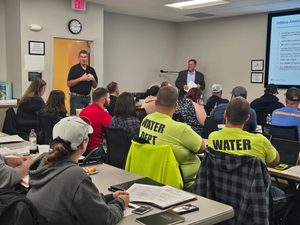
As the operator certification program lead, Scott Ham has been able to work directly with operators in a fast-paced, in-person course that creates strong outcomes for both internal and external operators. Indiana American Water notes that the program has between a 90% to 95% operator certification success rate.
Ham believes the operator certification program has been such a success due to the collaboration with different utilities and state organizations.
“We have a great partnership with several groups for the operator certification for drinking water and wastewater under the direction of the Indiana Department of Environmental Management (IDEM),” Ham said. “These organizations collaborating with Indiana American Water have proven to be extremely successful; they are the ones that deal directly with all the public water supplies in Indiana. This collaboration has been able to reach the entire state, offering non-proprietary training that is guided by the state for the state exam and certification.”
The Indiana Section of American Water Works Association, the Alliance of Indiana Rural Water and Indiana American Water are all part of the effort to keep strengthening the talent and knowledge workforce in the Hoosier state.
Working closely with IDEM to create training manuals and exam preparation materials, the program equips future operators with the knowledge and skills needed to earn certification and succeed in the field. Ultimately, the program helps build the next generation of water professionals who play a vital role in protecting public health and providing safe drinking water to communities across Indiana.
Another benefit of the program is the positive impact it has on workforce development. Within high schools, vocational schools, technical colleges, and some of the college workforce, the local options and different careers are endless.
“Whether it’s in distribution, construction, treatment, engineering, water quality, lab, chemistry, biology — it’s everything in that nature. We always build our team, build our bench, and then look in the pipeline and who is coming up next,” Ham said.
Indiana American Water, and the industry of certified operators as a whole, is always looking for ways to galvanize the young troops into a career in the field.
“Like most industries, we’re facing a graying workforce. There are a lot of retirements on the horizon. We want to not only get younger people interested in careers but also get them on a path to receive the certifications necessary to be operators or field technician, long-term,” said Joel Reuter, external affairs manager at Indiana American Water.
The training program at Indiana American Water goes beyond simple classroom instruction. Operators participate in extensive courses such as 50 hours of distribution system training, 80 hours of water treatment (WT) training, and 50 hours of wastewater training. Through investing in regional training centers throughout the state, such as Silver Creek and Gary, operators are able to have access to modern training tools, interactive learning experiences, and real-world environments.
Qualification and education are necessary to meet and exceed industry standards. According to Ham, how the next generation embraces technology has transformed into a great asset for these individuals.
The certification levels for distribution service licenses and WT can vary. For the distribution system, there are three levels: small, medium, large. Six different classifications are defined for WT.
“For small distribution, it is less than 500 people and can refer to a little campground or a gas station. A medium certification can go up to 10,000 people, and the large certification generally exceeds that,” Ham said. “WT1 is just groundwater out of a well, WT2 has chemical treatment, and WT3 is wells, which is groundwater with filters. Both WT4 and WT5 are surface water like lakes, streams, rivers, and ponds. WT4 is smaller systems, and WT5 is larger systems. WT6 is for emerging technology, which are site-specific — East Chicago, Lake Santee. It takes a very important, certified operator to run those specific systems, and it’s just changing all the time with new regulations.”
Other examples of smaller systems that can benefit from certified operators include recreational campgrounds, power plants, and small-town rural systems that are under 100 people and need local operators to take care of daily operations for safe drinking water.
“Sometimes, operators can take care of more than one system,” Ham said. “As long as they can adequately supervise it, you may have one certified operator that is taking care of a mobile home community or small community campground. It’s huge because as they go through the certification course, it helps provide them with expertise.”
While organizations like Indiana American Water have been able to benefit from this statewide training initiative, the participation level has been growing throughout the state. Ham encourages individuals who are interested in becoming a certified operator to participate in the program to refine their skills in high-demand roles such as plant operators, transmission and distribution employees, and field service representatives.
Once a person achieves their licenses and accreditation, that person carries those credentials throughout their lifetime, no matter where their careers take them.
“There is a huge need for certified operators,” Ham said. “We’re showing some grace, as we want to max out the course at 45 people. I had 81 in November of 2025, and 63 in May of 2026. The good news is we’re making seats at Indiana American Water’s main offices in Greenwood. These operators will get a really good, intensive course on treatment distribution. There are prerequisites, just like college, so people will know what they need to prepare for before showing up.”
The Drinking Water Operator Exam Review Course, which will be orchestrated by Ham, will take place between November 2-5, followed by an exam on November 6, 2026. The exam is proctored by IDEM. You can register with the Alliance of Indiana Rural Water or Indiana Section AWWA online.
For more information on Indiana American Water, you can visit www.indianaamwater.com
