Michigan City hosts annual ‘Power Breakfast’ focusing on transit oriented development

- By: Samantha Marino
- Last Updated: March 25, 2026



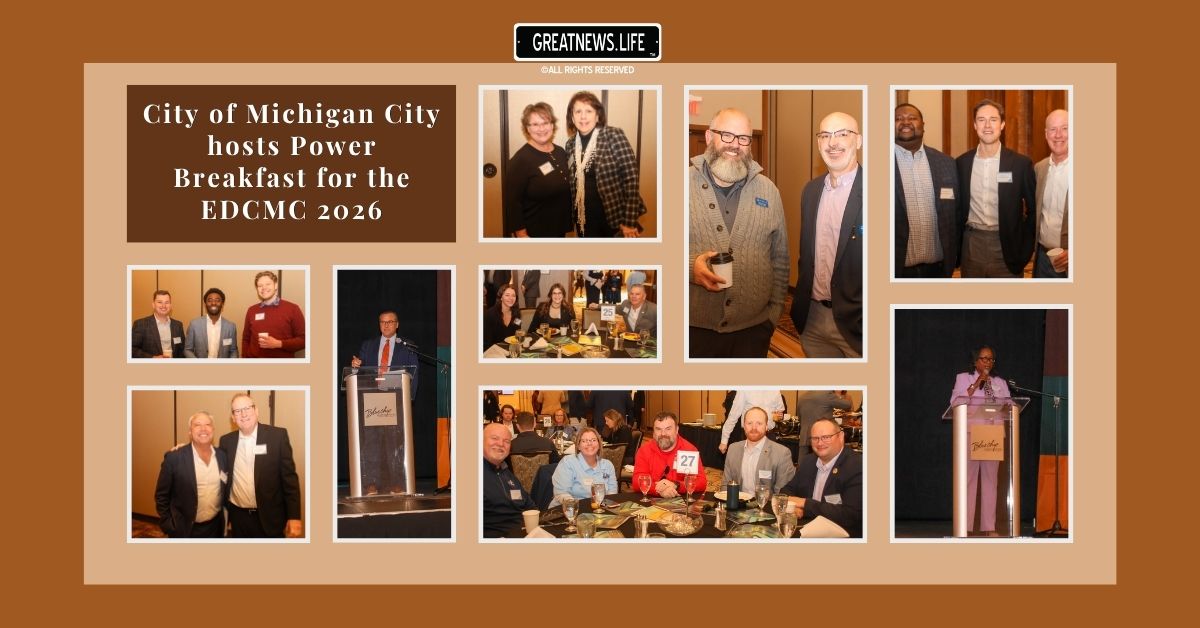
The Economic Development Corporation of Michigan City (EDCMC) hosted its fourth annual Power Breakfast at the Blue Chip Casino, paying special attention to transit-oriented developments (TODs) and their ripple effects across Northwest Indiana.
The gathering drew more than 300 attendees, including city officials, EDCMC board members, sponsors and regional partners representing public, private and nonprofit sectors. Much of the discussion centered on how TODs tied to the South Shore Line’s expansion are shaping growth in Michigan City and Hammond, marking the first major expansion of the line in more than a century. Guests got the chance to enjoy breakfast and coffee while mingling with other community leaders.
Michigan City Mayor Angie Nelson Deuitch and Hammond Mayor Thomas McDermott Jr. outlined the path their cities have taken in developing TODs, along with how those efforts are influencing investment, housing, and future opportunities. Sherri Ziller, president and CEO of the Northwest Indiana Regional Development Authority, moderated the discussion.
“Michigan City is growing. We have been intentional about preparing for it. We’ve built the capacity, improved our processes, and continue to align our team to meet the moment. You can see it in the level of investment, the housing pipeline, and the activity happening across our community,” said Nelson Deuitch.
Michigan City’s TOD is anchored by the newly refurbished 11th Street Station and the adjacent mixed-use high-rise development, The Franklin at 11th Street, which is expected to welcome its first residents in 2026.
Hammond’s efforts center around the Hammond Gateway Station and the South Shore Line’s West Lake Corridor Project, with additional long-term plans tied to the Monon Corridor.
“One of the things I’m most proud of as mayor is that I’m not afraid to make decisions. I weigh them, and then I move forward. It doesn’t always work out perfectly — sometimes it blows up — but you can’t let that stop you,” McDermott said. “I think about it like baseball: Hall of Fame players fail 70 percent of the time. The only way you don’t win is if you don’t get in the batter’s box, so I’ll take the swing every time.”
Beyond infrastructure, both cities emphasized the broader economic impact of TODs, including increased development activity, job creation, and private investment. Michigan City reported significant gains in 2025, including 985,409 square feet of commercial space added or redeveloped, 967 new jobs, and an estimated $1.3 billion in total capital investment. Leaders also noted that approximately 2,000 residential units are under construction or in the permitting pipeline over the next five years, alongside plans for two new business parks.
Clarence Hulse, executive director of EDCMC, said the organization continues to work closely with local leaders to sustain momentum and guide future development. He described Michigan City’s approach as a long-term commitment to innovation and strategic growth.
“While innovation may be seen as a buzzword that is thrown around to describe anything new and unique, it is truly a direction that Michigan City has been working towards for years and continues to follow with new ideas, economic development approaches and ingenious mindsets,” Hulse said.
Hulse also pointed to the impact of TOD-related projects, including the South Shore Line’s Double Track initiative and The Franklin at 11th Street, as catalysts for revitalizing downtown and expanding its boundaries to accommodate continued growth. He added that TODs improve access to essential services while making more efficient use of land.
“TODs not only prompt easier access to what residents need to live, work and thrive through walkability, but also encourage more effective use of the land,” Hulse said.
The mayors also discussed how their respective TODs are shaping future development. McDermott pointed to Hammond’s evolving landscape, including new hospitality and residential growth, the transformation of previously underutilized areas and the exciting possibility of the Chicago Bears calling Hammond home.
Looking ahead, Nelson Deuitch said housing remains a top priority as Michigan City continues to expand its downtown and prepare for increased demand while ensuring infrastructure keeps pace with growth.
The event concluded with an open question-and-answer session, where audience members submitted questions on everything ranging from data centers to the arts.
For more information on the EDCMC, visit edcmc.com.


