Neuroscience major presents work on Alzheimer’s early detection
- By: Indiana University Northwest
- Last Updated: March 18, 2026



Alzheimer’s disease is all too common in the United States, with many people knowing someone with the diagnosis. Thankfully, new Alzheimer’s research is frequently being published, including studies on early detection.
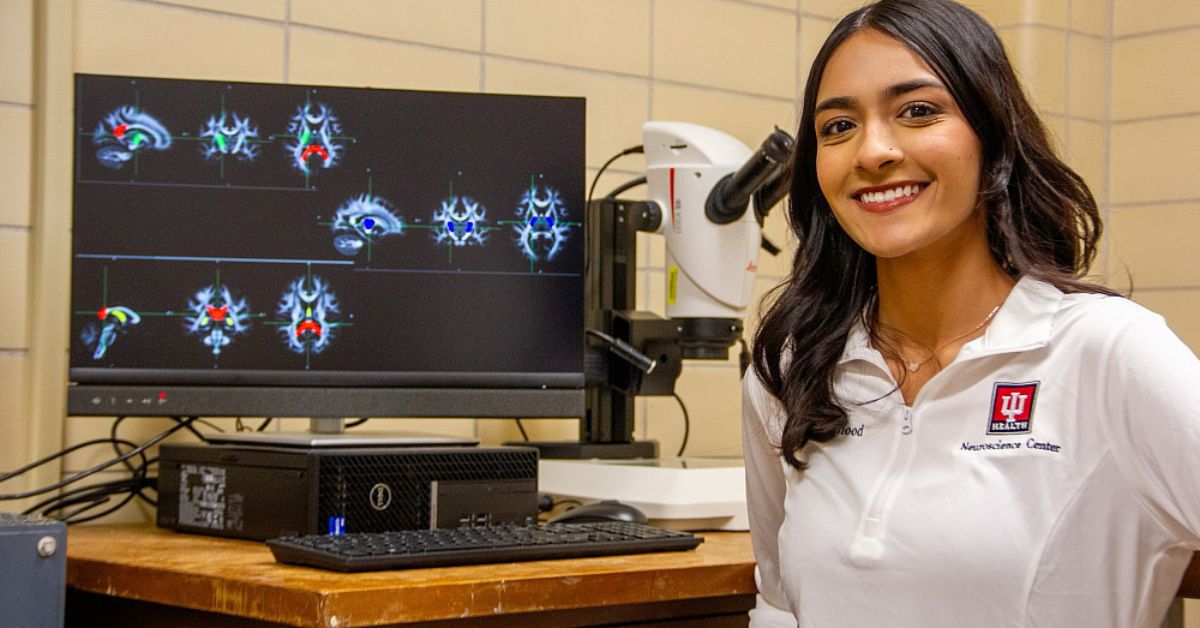
Mina Mahmood, a neuroscience major at Indiana University Northwest, has worked on some of this research herself.
In the summer of 2025, she headed to Indianapolis for a student research program that promotes health data science and AI, Datawiz-IN. Thanks to a stipend, Mahmood was able to stay on the IU Indianapolis campus while diving into Alzheimer’s disease research at the IU Health Neuroscience Center.
“They were interested in finding a less invasive method for detecting Alzheimer’s,” Mahmood said. “My project aimed at evaluating whether transcriptional risk scores (TRS), which can be derived from a simple blood test, could be as effective for early detection as established biomarkers, such as MRI measures of brain structure and cerebrospinal fluid, including amyloid-β (Aβ) and tau proteins, which are commonly used in Alzheimer’s diagnosis today.”
As it turns out, that simple blood test was somewhat effective at detecting Alzheimer’s disease early.
“It was my job to analyze the data to see if our results were significant, which was really interesting,” she said. “As I kept running the numbers, I was like, ‘there’s a trend here that’s actually significant.’”
Mahmood’s journey with this research didn’t end when the summer ended, either. In February, she presented her work at Regionals at the Rotunda, an event at the Indiana Statehouse that showcases student research across IU regional campuses.
Mahmood shared her findings with other students and IU administrators and even met with a state representative who was concerned about the impact memory loss could have on him as he aged. She was also approached by the IU Lab for another research opportunity.
Mahmood has seen a wave of success from her participation in student research, but it almost didn’t come to pass. When she initially expressed interest in the summer program, she didn’t think she was eligible.
“I was told there were a bunch of barriers that would prevent me from doing it,” she said. “But I wasn’t going to take no for an answer, so I just kept asking about it.”
Eventually, her persistence paid off, and Mahmood found herself working on Alzheimer’s research with real-world applications. She was the only undergraduate student in the group.
“It was a huge learning curve for me, but I’m grateful now that they treated me like the PhD students,” she said. “I learned a lot, going through the same methods they were using.”
Undergraduate student research isn’t the norm at some universities, but at IU Northwest, students at all levels are welcomed to get involved.
Maureen Rutherford, associate professor of psychology, is glad to offer such opportunities to students, even as early as their first year. She’s developed a tiered program that introduces students to research in phases. First, they learn the basics and ethical guidelines, then in subsequent years, they design their own projects and analyze data.
“I’ve tried to build this up in stages,” Rutherford said. “It’s been a really good strategy for building skills and building a community of student researchers.”
In Rutherford’s eyes, undergraduate student research benefits everybody. Not only does she get fresh perspectives on her work, but students come away with stronger critical thinking skills.
“Students who have had research experiences just understand things a little better,” she said. “Their writing is better; their thinking is better; they ask better questions.”
Mahmood herself is a part of Rutherford’s lab and is delving back into research with the skills she developed in Indianapolis. This semester, she’ll be looking at nicotine exposure on zebrafish and how nicotine and vape products affect stress responses.
“I can take what I’m learning through these research experiences and apply it to my current job at the hospital, and then I can continue to apply it if I pursue a career in medicine,” Mahmood said.
Mahmood’s research experience has given her a wealth of knowledge that will be applicable whether she goes on to medical school or decides on a different route in the future. She said she wouldn’t be where she is today if she’d stopped looking for opportunities or let a rejection get her down.
“Go out and make your own opportunities,” she said. “I go digging on my laptop or just talk to people. Get active and be communicative with your professors.”
Rutherford echoes this sentiment. She looks forward to students approaching her about work in the lab.
“We picked this job because we want to make connections with our students,” she said. “Sometimes students tell me, ‘I don’t want to bother you,’ but please bother me! The ones I get to know are who I think of when I see an opportunity.”
IU Northwest students like Mahmood are reaping the benefits of student research opportunities, whether that’s in Rutherford’s lab on campus or a niche program they found from their own drive and curiosity. Nevertheless, Mahmood is proof that when you seize every opportunity and persist through barriers, you can achieve your goals and then some.
