Regional student researchers shape their fields of study and Indiana’s future
- By: Indiana University Northwest
- Last Updated: February 19, 2026



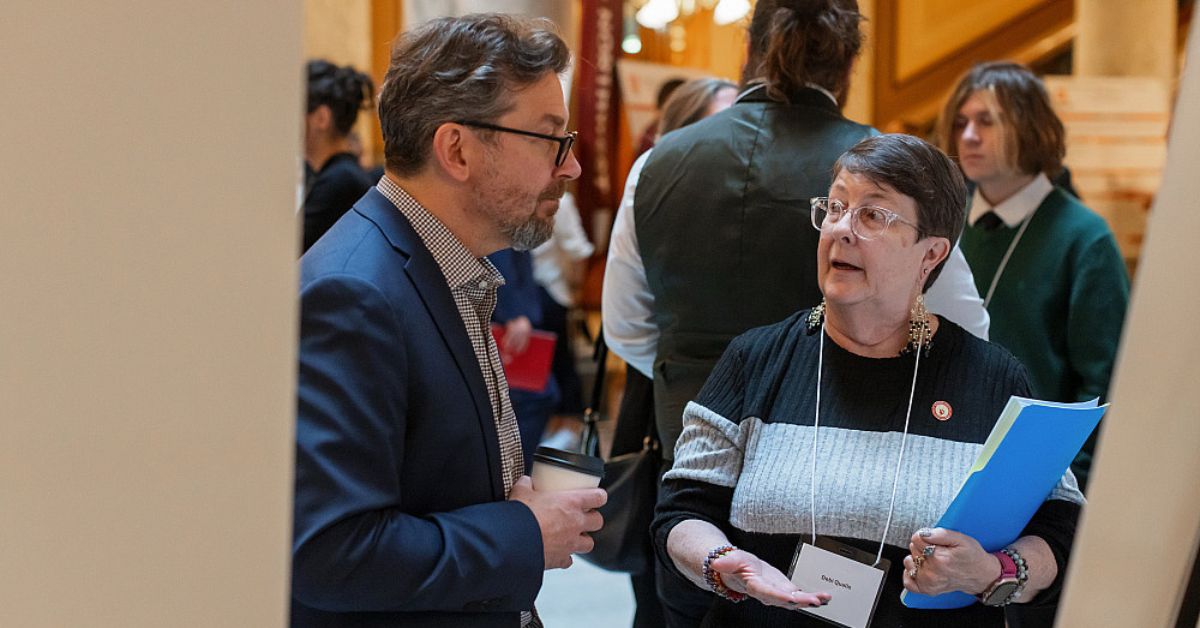
With 18,000 students, Indiana University’s regional campuses are engines of discovery for counties across the state. Students are trained for research, uncovering insights deeply connected to their communities while advancing their respective fields of study. This was on display at the Regionals at the Rotunda event Feb. 18, where 56 student researchers presented more than 40 projects to lawmakers.
Five of those students highlight how they’re shaping the future of cancer treatment, improving cybersecurity, safeguarding Indiana’s ecology and memorializing Hoosier history.
Sophomore Debi Qualls was already an employee at IU Northwest when she decided to pursue her bachelor’s degree. She took an African American history course and said she was shocked by how little she knew about the subject in general, especially the Underground Railroad and Indiana’s involvement.
“We learned a little bit about the Underground Railroad in elementary school, and again in high school, but we didn’t learn about Indiana’s role,” said Qualls, who lives in DeMotte, Indiana. “However, Hoosiers were extensively involved in helping freedom seekers find their way to Canada.”
She gathered information from the Calumet Regional Archives in the Anderson Library at IU Northwest and searched for publicly available information online, consolidating mentions of Hoosiers’ Underground Railroad history into a single reference list of books, articles, documents and websites. It highlights Hoosier Quakers, the route along the Little Calumet River, interviews of former slaves residing in Indiana and more.
Qualls said that Indiana education should focus more on the Underground Railroad and African American history, especially Hoosiers’ efforts toward liberation.
“Indiana has a very rich history, and students should learn more about it,” Qualls said. “Learning about historical events like the Underground Railroad and events that connect Indiana to the rest of the country can bring us together in ways we might not have imagined before.”
Senior Alexis Evans received a scholarship to IU Southeast, making college affordable while staying close to her home in Charlestown. She helped assistant professor of biology Margaret Wallen investigate how mutations in cancer genes can inform lung cancer treatment.
Lung cancer is the leading cause of cancer-related deaths in Indiana. While new therapies can target a patient’s specific tumor profile, many lung cancer patients do not have access to these treatments and continue to receive standard chemotherapy. Evans’ research aims to personalize treatment options for lung cancer patients. She found that distinct mutations of the p53 gene led to differences in treatment responsiveness and growth rate.
“Regional campuses are committed to addressing issues within our home state,” Evans said. “I hope our findings about this particular p53 mutation, as well as future research, will provide a better understanding of how to treat lung cancer patients individually, using the most effective chemotherapeutics against their particular genetic mutation.”
Junior Jackson McCullough, from Arcadia, Indiana, chose IU Kokomo due to its computer science prowess and affordability. He researches an often-overlooked area of cybersecurity: drones. In Indiana, drones are increasingly used in agriculture for crop management and by hospitals for time-sensitive deliveries.
McCullough used game theory to generate cyberattack scenarios and identify the best methods of defense. For example, he mathematically analyzed a specific attack where hackers overwhelm networks with malicious Wi-Fi traffic, which causes the drone operator to lose control. Then McCullough used game theory to test defense strategies.
Early results show that game theory can improve the safety and reliability of drone networks. Certain equations can determine when a drone has been compromised. McCullough said that governments and industries can assign a safety standard to a drone using the equations.
“These are the kinds of security standards that can be put in place anywhere,” McCullough said. “The best defense is prevention. Game theory can help you do that mathematically.”
Washington, Indiana, resident Jerrica Miles worked as a veterinary technician for a decade before deciding to make a career change. She turned to IU Online to earn a bachelor’s degree in sustainability studies through IU East. Miles studied the benefits of pollinator gardens in rural communities.
“I was aware of research about urban pollinator gardens, but there weren’t as many studies on rural communities,” Miles said. “Since Indiana is an agricultural state, it is dependent on pollinators like bees and butterflies because they play a role in 70% of food crops people eat.”
In addition to pollination, insects contribute nutrient cycling and decomposition. But the populations of these “service bugs” are dwindling.
“We are starting to near a point of no return and need to focus on conservation efforts that actually work,” Miles said.
Early findings show that small pollinator gardens do have a positive impact on the ecological health of agricultural areas. By widening food options throughout the year, pollinator insect populations that support Indiana’s ecosystems can thrive.
IU South Bend senior Milo Moss of Mishawaka has similar interests in insects and ecology. South Bend’s newly launched tree planting initiative was a perfect opportunity to investigate urban tree canopy — the number of leaves and branches that provide shade cover in an urban area. The city wants to increase urban tree canopy from 22% to 40% by 2050.
Moss investigated the current state of soil health in South Bend greenspaces and vacant lots and measured the variety of invertebrates like ants, mites, beetles and springtails. Moss also determined the rate of microbial decomposition, which includes studying fungi and bacteria in the soil. He also examined the soil’s water-holding capacity and the amount of organic matter present.
The results suggest that an increased density of native tree species in urban areas promotes a healthy soil ecosystem. This also benefits human health by decreasing soil pathogens, breaking down soil pollutants and improving human immune function.
“I imagine a near-future Indiana where native tree planting initiatives take root in urban communities across the state, and conditions like the urban heat island effect, stormwater runoff and soil pollutants are slowly minimized,” Moss said.
